


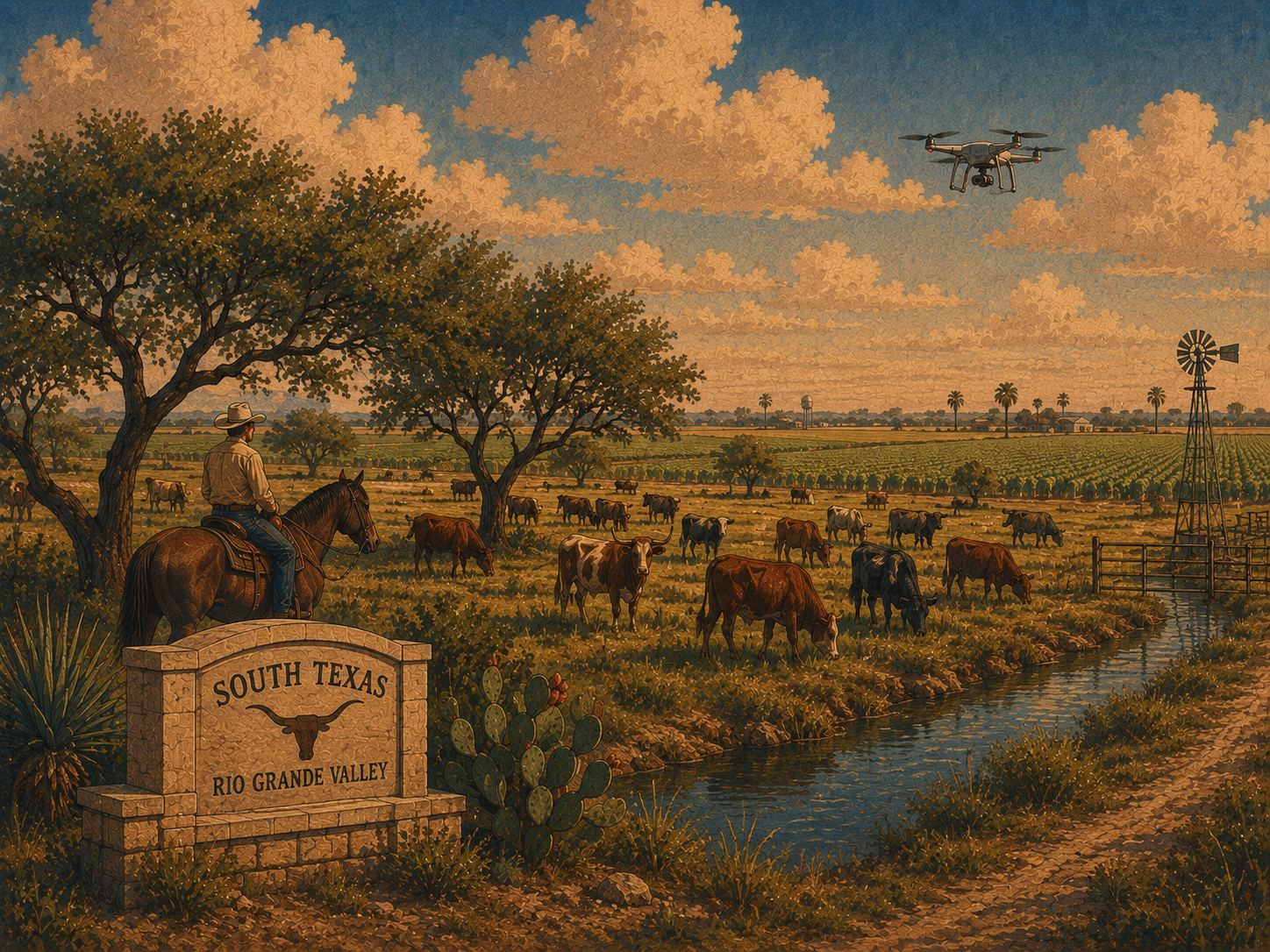
Federal officials have turned to artificial intelligence and border-security hardware to fight a decades-old agricultural threat that has been creeping back toward Texas. U.S. Secretary of Agriculture Brooke Rollins and U.S. Customs and Border Protection Commissioner Rodney Scott held a press conference in Edinburg to announce a new joint initiative using AI-equipped CBP drones to detect livestock and wildlife infected with New World screwworm across the Rio Grande Valley.
The New World screwworm is the larval stage of a fly whose maggots burrow into the open wounds of warm-blooded animals, feeding on living tissue rather than dead flesh — a trait that makes untreated infestations often fatal to livestock and can also affect pets, wildlife and, rarely, humans. The United States eradicated the pest domestically decades ago through a sustained sterile-fly release program, but it has been advancing north through Mexico in recent years, prompting renewed federal attention along the Texas border.
Under the new agreement between USDA and CBP, the USDA gains access to CBP's fleet of drones, which are equipped with thermal imaging and AI-driven detection software originally developed for border-security surveillance. "If the drones are seeing a herd of white-tailed deer, they can spot the deer, and then that technology can zero in on it if there is one or two that have a higher temperature than the others — there is a good chance they have a New World screwworm," Rollins said at the announcement. She described the effort as the first of a two-step response: identifying likely infections from the air, then following up with sterile fly releases in affected areas to interrupt the pest's breeding cycle.
The scale of the operation has grown quickly. According to USDA figures, the agency has conducted more than 1,000 drone surveillance flights across Texas since early June, observing more than 20,000 animals as part of an expanded wildlife-monitoring program run jointly with the Texas Parks and Wildlife Department. Officials say the drones are also helping identify cases of ranchers illegally moving livestock across the region, a secondary benefit for an agency also focused on preventing the pest's spread through unauthorized animal transport.
The initiative comes as the USDA also accelerates infrastructure meant to fight the pest longer-term: a $750 million sterile-fly production facility under construction in Edinburg is now set to open in April, seven months ahead of its original schedule, following a similar facility strategy used decades earlier to eradicate the pest from the U.S. the first time. Russell Boening, co-owner of Boening Bros ranching operation in San Antonio and a cattleman of more than 70 years, welcomed the drone program but cautioned against complacency. "The fight is not over. We still need to be vigilant. We need to watch our cattle, our livestock, and our wildlife, but it is heartening for me," Boening said. For South Texas ranchers and rural landowners, the message from officials has been consistent: report suspected cases promptly, keep close watch on animals with open wounds, and expect a more visible federal presence — airborne and otherwise — along the border in the months ahead.