


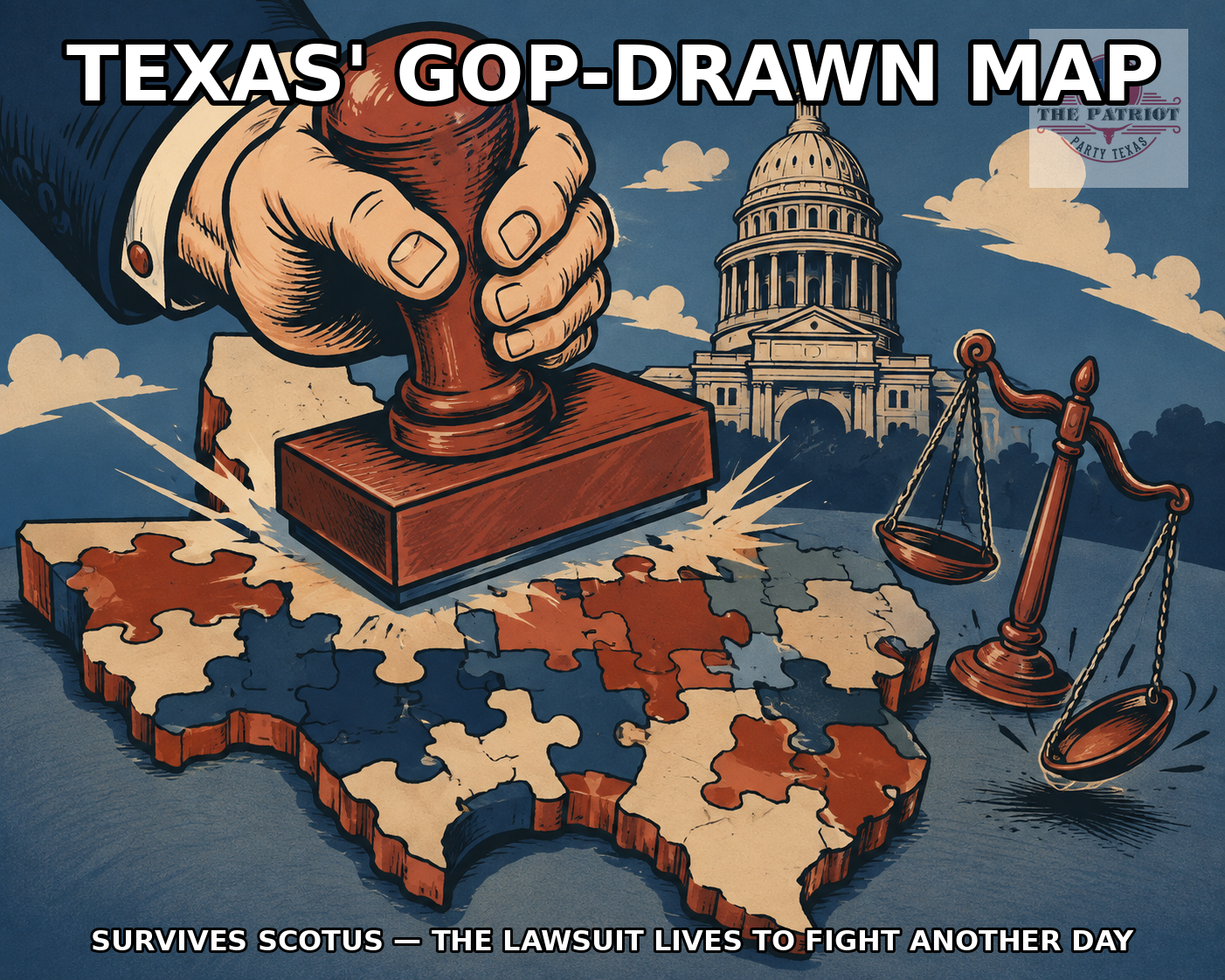
Texas will use its newly redrawn congressional map for the 2026 midterm elections after the U.S. Supreme Court twice intervened to keep a lower court from blocking it — first with an emergency stay in December 2025, then with a final reversal of the lower court's ruling in April 2026.
The map itself dates to August 2025, when the Texas Legislature passed a mid-decade redistricting plan targeting five Democrat-held congressional seats, a move state Republican leaders pursued outside the normal once-a-decade redistricting cycle. Analysts have said the new lines could net Republicans as many as three to five additional U.S. House seats.
Democratic voters and civil-rights groups sued, arguing the map amounted to an unconstitutional racial gerrymander. In November 2025, a three-judge federal panel agreed, barring the state from using the new map for the 2026 elections. That ruling threatened to throw the state's election calendar into chaos, with a Dec. 8, 2025 candidate-filing deadline fast approaching.
The Supreme Court stepped in on an emergency basis in early December 2025, pausing the lower court's order and allowing Texas to proceed with candidate filing under the new map. Writing for the majority, Justice Samuel Alito said it was "indisputable" that Texas lawmakers' motivation was partisan advantage — which the Supreme Court has previously held is constitutionally permissible, even when race and party affiliation closely correlate in a given area.
The Supreme Court made that stay effectively permanent on April 27, 2026, formally reversing the panel's ruling and allowing the map to remain in place through the 2026 elections while the broader gerrymandering lawsuit continues in the lower courts. Justices Sonia Sotomayor, Elena Kagan, and Ketanji Brown Jackson dissented from that decision.
By the time the Supreme Court issued its final word, Texans had already voted under the new lines: the state's March 3, 2026 primary drew record turnout of more than 4.4 million voters, with Latino turnout up 37% in majority-Latino districts — many of them precisely the districts redrawn to shift partisan advantage. Roughly three-quarters of Latino voters in those areas cast ballots in the Democratic primary, according to turnout analysis of the results, complicating both parties' assumptions about how the new map would play out in practice.
The map's ripple effects reached beyond the House races it was designed to reshape. U.S. Rep. Jasmine Crockett, whose Dallas-based district was among those redrawn, opted to run for the U.S. Senate rather than seek re-election to her House seat — and lost the March 3 Democratic Senate primary to state Rep. James Talarico, 53%–45%.
For Texas voters, the practical upshot is straightforward: the district lines in place for the 2026 midterms are the ones the Legislature drew last August, not the boundaries a federal panel tried to block. The underlying legal fight over whether those lines constitute an unconstitutional racial gerrymander has not been resolved — it continues in the lower courts even as this year's elections proceed under the new map. Voters who want to confirm which congressional district they're now in, given the boundary changes, can check their registration and district assignment through the Texas Secretary of State's office ahead of the November general election.