


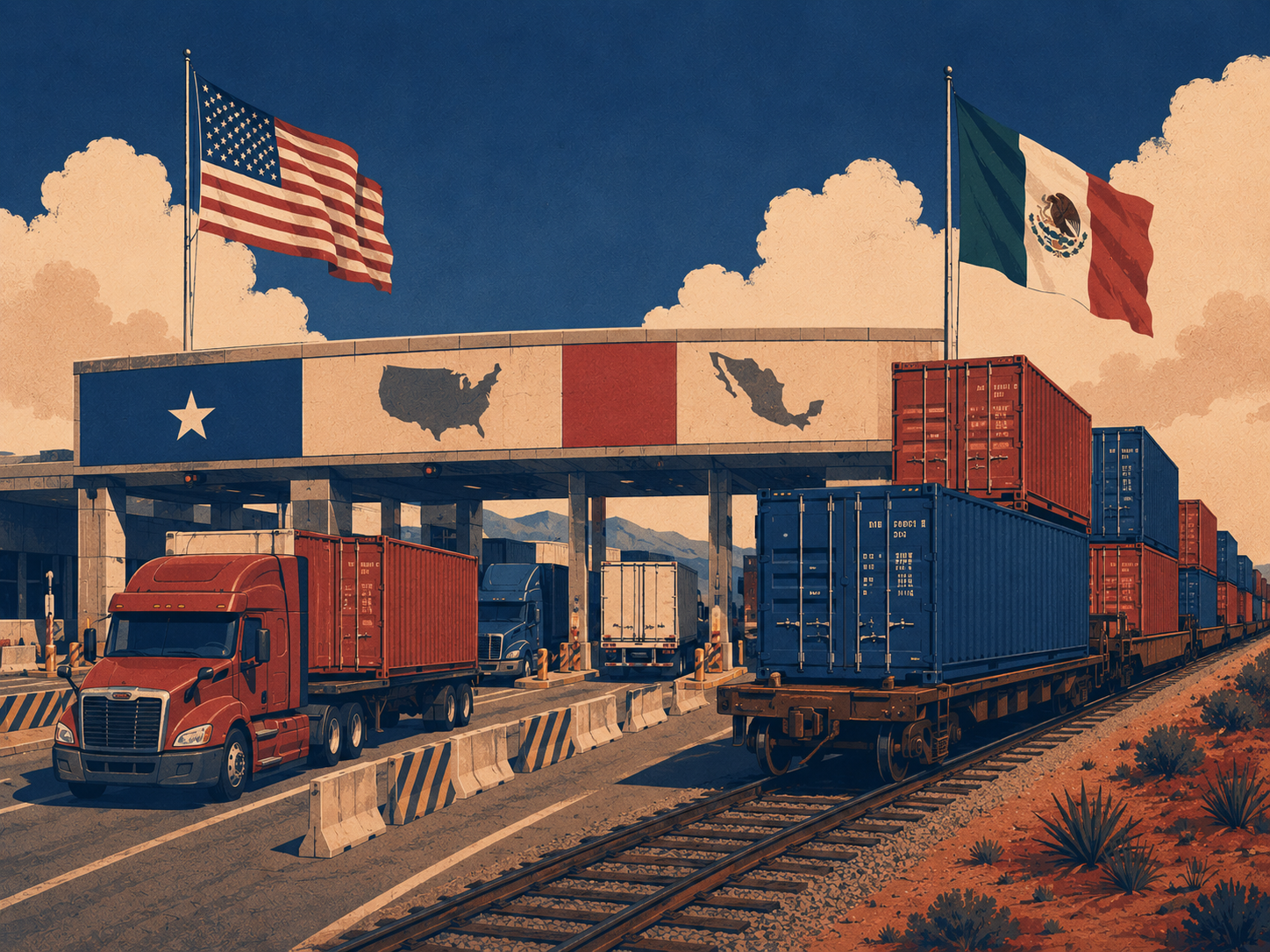
The Trump administration announced July 1 that it would not renew the United States-Mexico-Canada Agreement (USMCA) as originally scheduled, instead placing the pact under an annual review process — a shift that has left Texas businesses that depend on cross-border trade unsure how to plan for the months and years ahead. Since the announcement, the U.S. has held bilateral trade talks with Mexico but not with Canada, while President Trump has separately imposed a new 10% tariff on a portion of Mexican imports and 50% tariffs on a range of Canadian goods, including cars and trucks.
The stakes for Texas are difficult to overstate. Mexico and Canada are the state's No. 1 and No. 2 trading partners, just as they are for the country as a whole, and the Texas Tribune has reported that roughly $350 billion in annual Texas trade — close to 12% of the state's economy — runs through the USMCA framework. That includes everything from Permian Basin energy exports and Gulf Coast petrochemicals to the manufacturing and logistics networks that have grown up along the border in cities like El Paso and Laredo over the three decades since NAFTA and its successor agreement reshaped North American trade.
What's changed most since July isn't a single new tariff — it's the uncertainty itself. Brett Preston, managing partner of the El Paso commercial real estate firm Cushman & Wakefield PIRES, put it bluntly: "We can't afford the tariffs or the duties, and we can't afford the risk regardless of how USMCA shakes out." According to Cushman & Wakefield PIRES, investment in new manufacturing and warehousing space is effectively at a standstill on both sides of the border, as companies that would normally be breaking ground on new distribution centers or expanding plants are instead sitting on their capital until they know what the rules will be.
Tony Payan, director of the Claudio X. Gonzalez Center for the U.S. and Mexico at Rice University's Baker Institute, described the deeper problem for businesses that plan in years, not quarters. "The problem is for businesses, because a lot of these companies — manufacturers, energy companies — they've got long-term plans," Payan said. "Companies are withholding their investment." That kind of pause has ripple effects well beyond the companies directly involved: fewer new construction contracts, slower hiring at logistics and manufacturing firms, and softer demand for the truckers, warehouse workers, and border-crossing infrastructure that keeps Texas's trade economy moving.
For Texas conservatives who have generally supported using trade leverage to secure better terms on immigration enforcement, fentanyl interdiction, and manufacturing reshoring, the USMCA standoff presents a real tension: many of the same border communities that back stronger enforcement also depend heavily on predictable, tariff-free trade with Mexico for their local economies. Even as the renegotiation drags on, one piece of the underlying framework remains intact — USMCA itself doesn't expire; it stays in place for at least another decade, through 2036, unless the parties agree to something different. That gives businesses some legal floor to plan around even as the near-term terms of trade stay unsettled. What Texas businesses are asking for, above all, is a resolution — in either direction — so they can start making decisions again instead of waiting on Washington.