


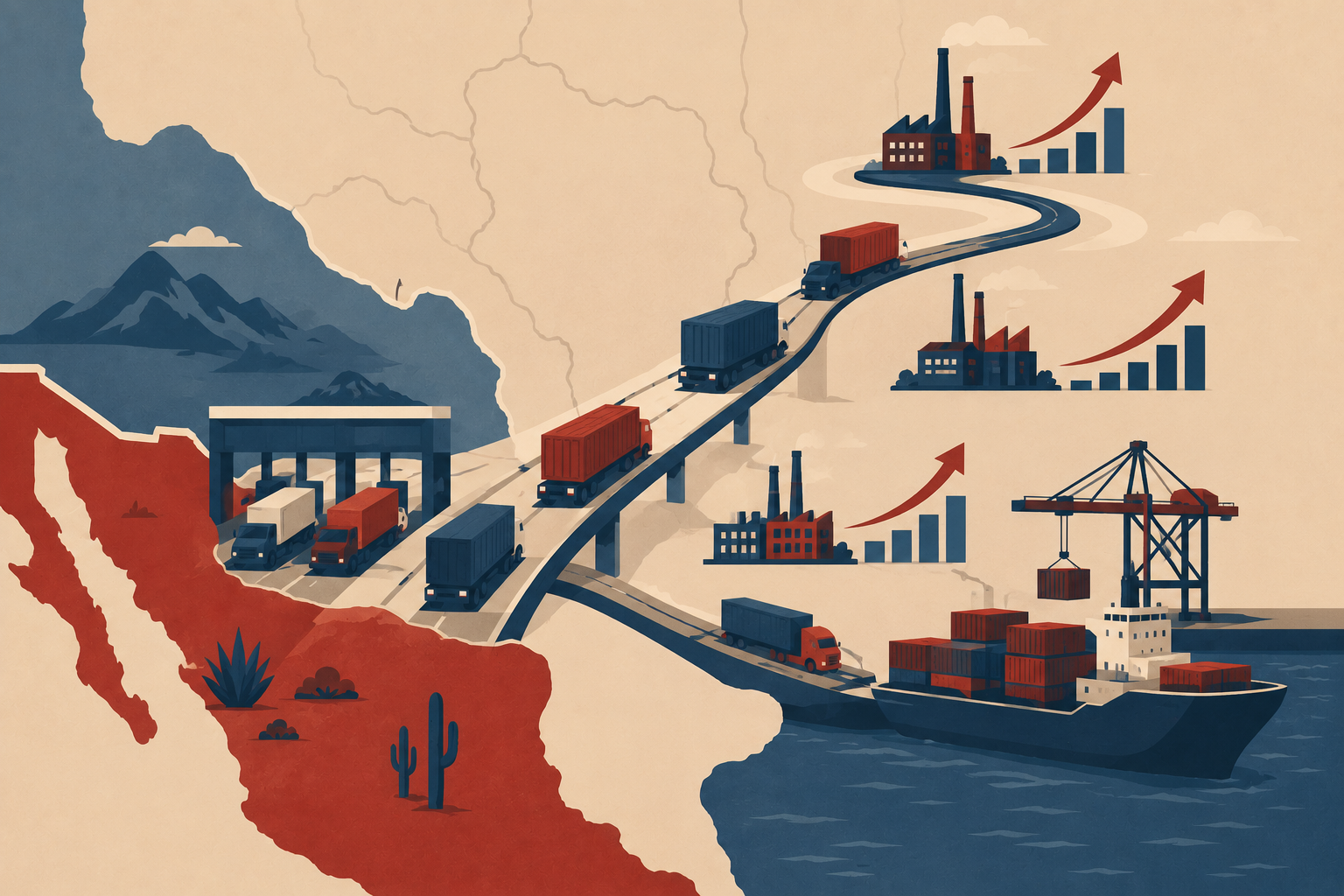
While Washington and Mexico City remain stuck in an unresolved fight over the future of the United States-Mexico-Canada Agreement, Mexico is quietly picking up manufacturing investment that used to flow to Asia — and Texas's border gateways are the ones handling the traffic. Mexico climbed from 25th to 19th place in Kearney's 2026 Foreign Direct Investment Confidence Index, one of the largest single-year jumps of any country in the survey, as global investors increasingly favor production hubs located close to the U.S. consumer market over factories half a world away, according to FreightWaves' analysis of the ranking.
The mechanics of the shift are logistical as much as political. A truck loaded at a plant in Monterrey can deliver components to a Texas distribution hub within roughly 48 hours; the same parts shipped by container from Shenzhen to the Port of Long Beach can take 20 to 30 days to arrive. As companies that spent the past decade sourcing from China look to shorten supply chains and reduce exposure to shipping disruptions and tariff swings, Mexico's geography has become a competitive advantage that's hard to replicate — and foreign direct investment into Mexican manufacturing has reached historic highs in sectors including automotive, green technology, medical devices and high-tech electronics, FreightWaves reported.
That investment is landing at Texas's doorstep. The Laredo and El Paso border crossings — already the busiest commercial ports of entry on the southern border — have posted record freight volumes as manufacturers accelerate the move of production from China to Mexican facilities, part of a broader "nearshoring" trend that logistics analysts expect to keep reshaping North American freight lanes through the rest of the decade. For Texas trucking, warehousing and logistics companies clustered along the I-35 and I-10 corridors, that means sustained demand — even as the same companies brace for the policy uncertainty hanging over the broader U.S.-Mexico trade relationship.
That uncertainty is real, and it cuts against a straightforward nearshoring story. The Trump administration announced July 1 that it would not renew the USMCA outright, instead putting the pact under annual review, and has since layered on new tariffs, including a 10% surcharge on a share of Mexican imports and additional forced-labor-related tariffs announced in July, according to Holland & Knight's analysis of the U.S. Trade Representative's actions. Critically, though, goods that qualify for duty-free treatment under USMCA's rules of origin remain exempt from those new tariffs — which is precisely why nearshored production, built specifically to meet USMCA's local-content requirements, has kept its edge over goods shipped in from outside North America entirely. Mexico, for its part, has moved in a parallel direction domestically, imposing its own tariffs ranging from 5% to 35% on 185 tariff categories covering textiles, footwear, steel and other manufactured goods — an effort, per trade analysts, to protect its own domestic manufacturers from the same cheap Asian imports that Texas and the rest of North America are also trying to compete with.
None of this means Texas is guaranteed to be the long-term winner. Toyota's recent decision to shift roughly 2,000 jobs from Tijuana, Mexico, to San Antonio — backed by a $303 million state and local incentive package, as reported by Texas Public Radio — shows that reshoring directly into Texas remains possible and, from a jobs standpoint, preferable to production simply relocating from China to Mexico instead of home. For now, though, the more common pattern is nearshoring rather than reshoring: manufacturing moving closer to the U.S. without moving into it. For Texas border communities and the freight economy built around them, that's still a tangible near-term benefit — even as the state's conservative congressional delegation continues pushing to finish a renegotiated USMCA that locks in long-term certainty rather than leaving billions in cross-border investment hostage to year-to-year tariff politics.